AIRCARE
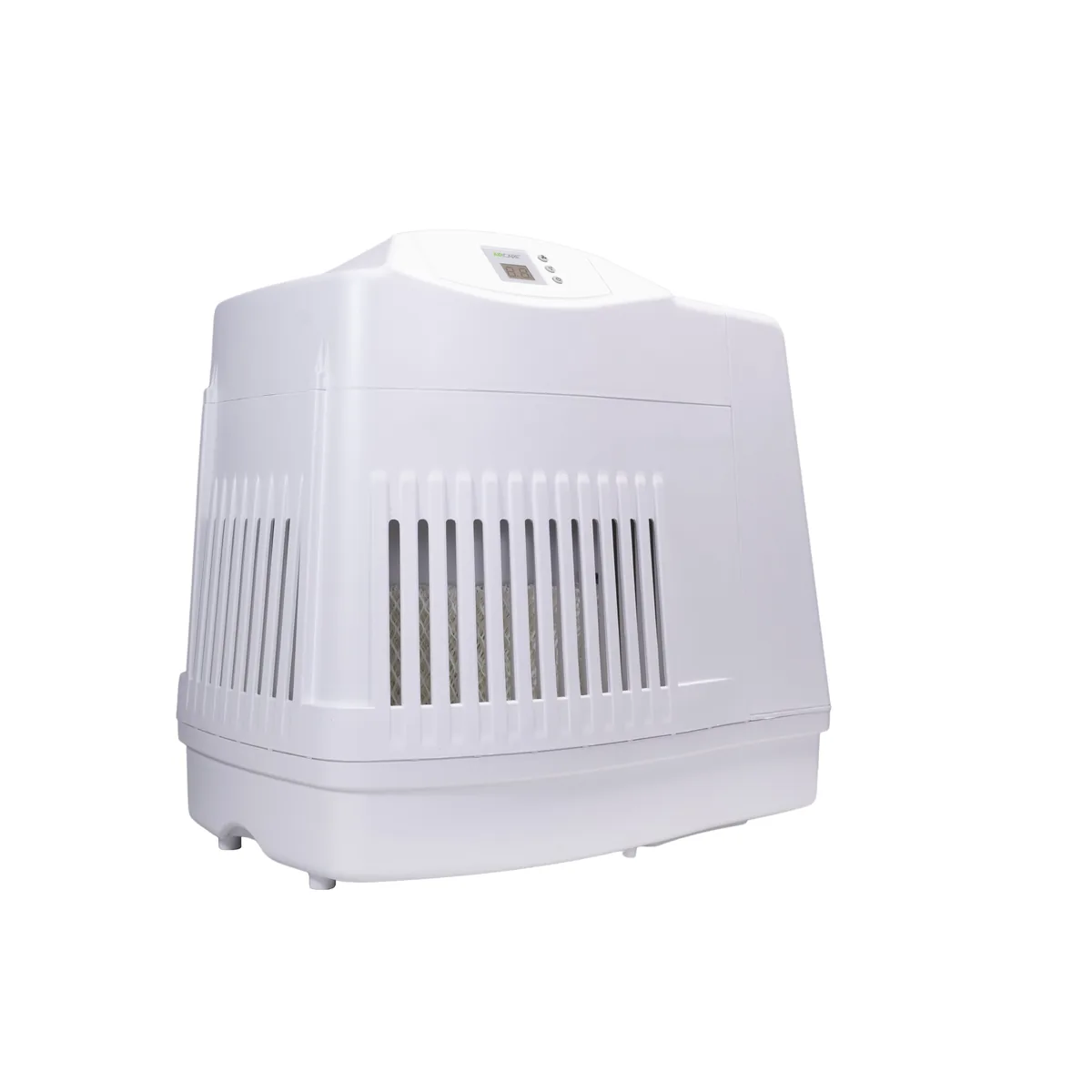
AIRCARE MA1201 Console
Twelve gallons a day is more than any other portable in this catalog by a factor of three, and it is the reason people with genuinely dry old houses end up here rather than buying four bedroom units. The load calculation puts 12 gal/day at around 2,950 square feet against AIRCARE's 3,600 - an overstatement of about a fifth, which in this category counts as restraint. The number that surprises people is the tank: 3.6 gallons feeding 12 gallons a day is roughly seven hours at full output. The 36-hour figure is the lowest of four speeds. Owners of dry houses fill this thing twice a day in January and consider it worth it.
The room-size claim, reconciled
2,956 sq ft supported · box says 3,600 sq ft
The box says 3,600 sq ft; the winter load calculation puts the output at 2,956 sq ft — an overstatement of about 22%, which is modest for this category.
Holding 3,600 sq ft takes about 15 gal/day, which drains this 3.6-gallon tank in roughly 5.9 hr — against the 36 hours AIRCARE advertises, which is measured at the lowest setting.
What a year costs
one MAF1 SuperWick at roughly $20, changed every one to three months in hard water - three a season is typical. Electricity assumes the rated 135 W for 12 hours a day across a 150-day heating season at 16¢ per kilowatt-hour.
Specifications
Maintenance profile
- Top fill
- No — tank comes off and goes to the sink
- Replaceable media
- Wick, replaced through the season
Facts, not a score. Which of these matter depends entirely on whether the unit ends up somewhere you will actually clean it.
Features
- 12 gal/day output - the highest of any portable here
- 3.6-gallon reservoir with a fill window
- Four speeds plus an auto setting driven by a built-in humidistat
- MAF1 SuperWick
- Check-filter indicator
- Optional demineralisation cartridge
- Evaporative - no white dust
Pros
- The only portable here with enough output to change the humidity in a whole floor of an old house, and owners describe exactly that
- Auto mode with a real humidistat, so it throttles back instead of running flat out
- No white dust despite the enormous throughput - everything mineral stays in the wick
- Cheaper to buy and far cheaper to install than any whole-house unit with comparable output
- Long enough in market that wicks, tanks and motors are all easy to source
Cons
- Seven hours per tank at full output - the 36-hour figure is the lowest speed, and in a dry January you will be filling it twice a day
- The wick turns to concrete in hard water; three a season at $20 each is normal and some owners buy more
- On high it is a loud appliance - nobody sleeps in the room with it
- 26 lb empty and over 50 lb full, so it lives where you put it
- 135W is real power draw for a portable
What owners say
Summarised from owner discussions and long-form owner reviews. Nobody here has used this unit.
The portable that competes with a furnace install. Twelve gallons a day is three times any other tabletop unit here, and owners with big old leaky houses arrive at it after everything smaller failed to move the reading.
The cost of that output is water and attention. The 3.6-gallon reservoir against twelve gallons a day is about seven hours at full tilt, and the 36-hour figure is the slowest of its four speeds — so in a cold snap owners describe filling it twice a day and considering it worth it. Hard water is unkind to a single wick moving that much throughput, and three replacements a season is a normal report.
It is also worth knowing that a demineralisation cartridge can be added, which is unusual for an evaporative and useful in very hard water for keeping the wick usable longer.
What owners like
- Enough output to actually change the humidity across a floor of an old house, which is why people with genuinely dry homes end up here
- Auto mode with a real humidistat, so it throttles back rather than running flat out
- No white dust despite the enormous throughput — everything mineral stays in the wick
- Far cheaper to buy and install than any whole-house unit with comparable output
- Long enough in the market that wicks, tanks and motors are all easy to source
Common complaints
- Seven hours per tank at full output — the 36-hour figure is the lowest of four speeds, and in a dry January owners fill it twice a day
- The wick turns to concrete in hard water; three a season at around $20 is normal and some owners use more
- On high it is a loud appliance and nobody sleeps in the room with it
- Over 50 lb when full, so it lives where you put it
Questions owners ask
How often will I fill it?
How long do the wicks last?
Can it live in a bedroom?
Console or whole-house?
AIRCARE MA1201 Console, head to head
Looked at alongside it
More from AIRCARE →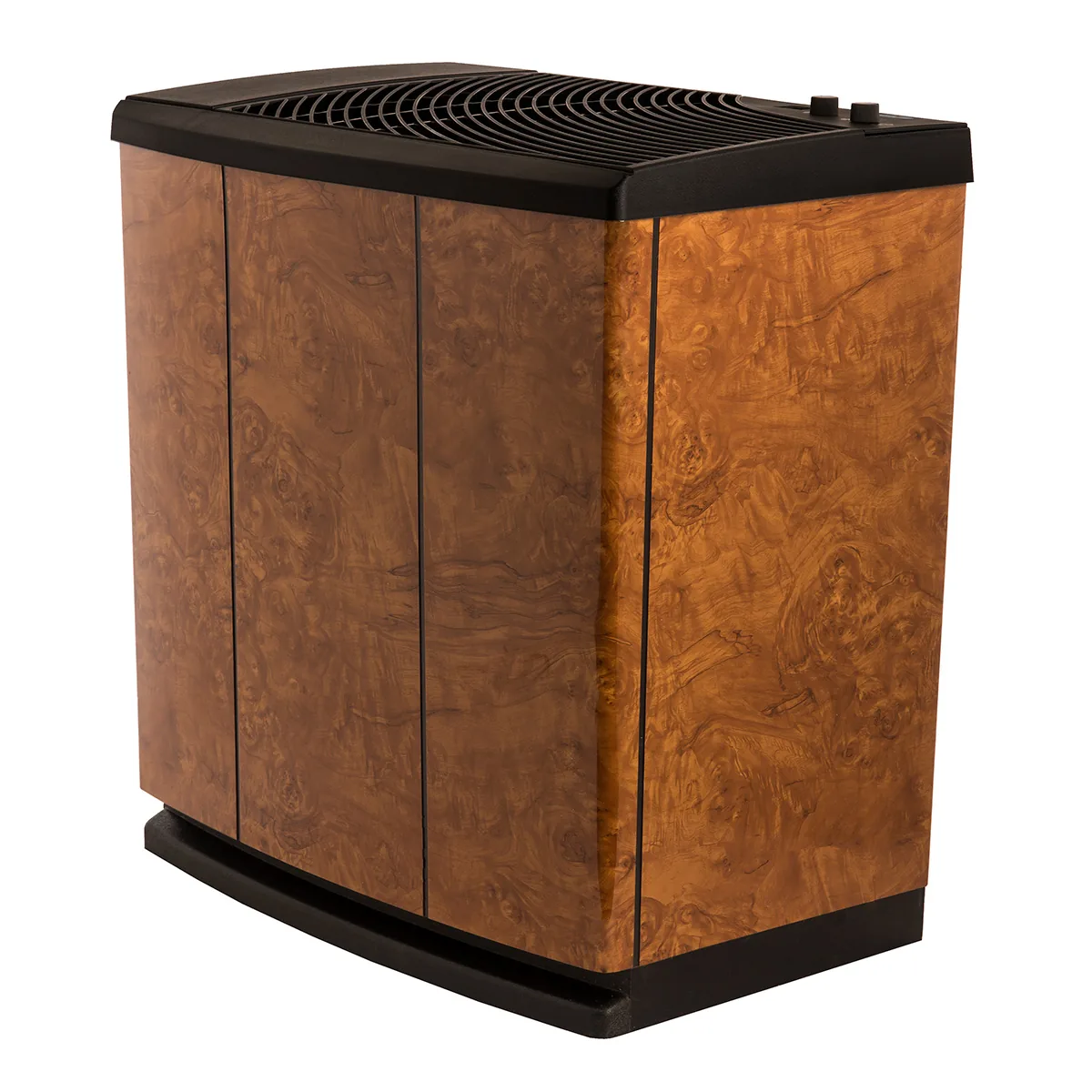
AIRCARE
AIRCARE H12-400HB Credenza
The MA1201's output in a credenza cabinet with half again as much water, which is the version of this machine that makes sense for a house you actually live in. Same 12 gallons a day, but 5.4 gallons of reservoir stretches the fill interval from seven hours to eleven at full tilt, and four speeds with an auto humidistat mean it rarely runs at full tilt. It is heavy, it is furniture, and at $280 it is the most expensive portable here - but it does a job that otherwise requires a plumber and a hole in your ductwork.
2,956 sq ft supported · box says 3,700 sq ft
AIRCARE
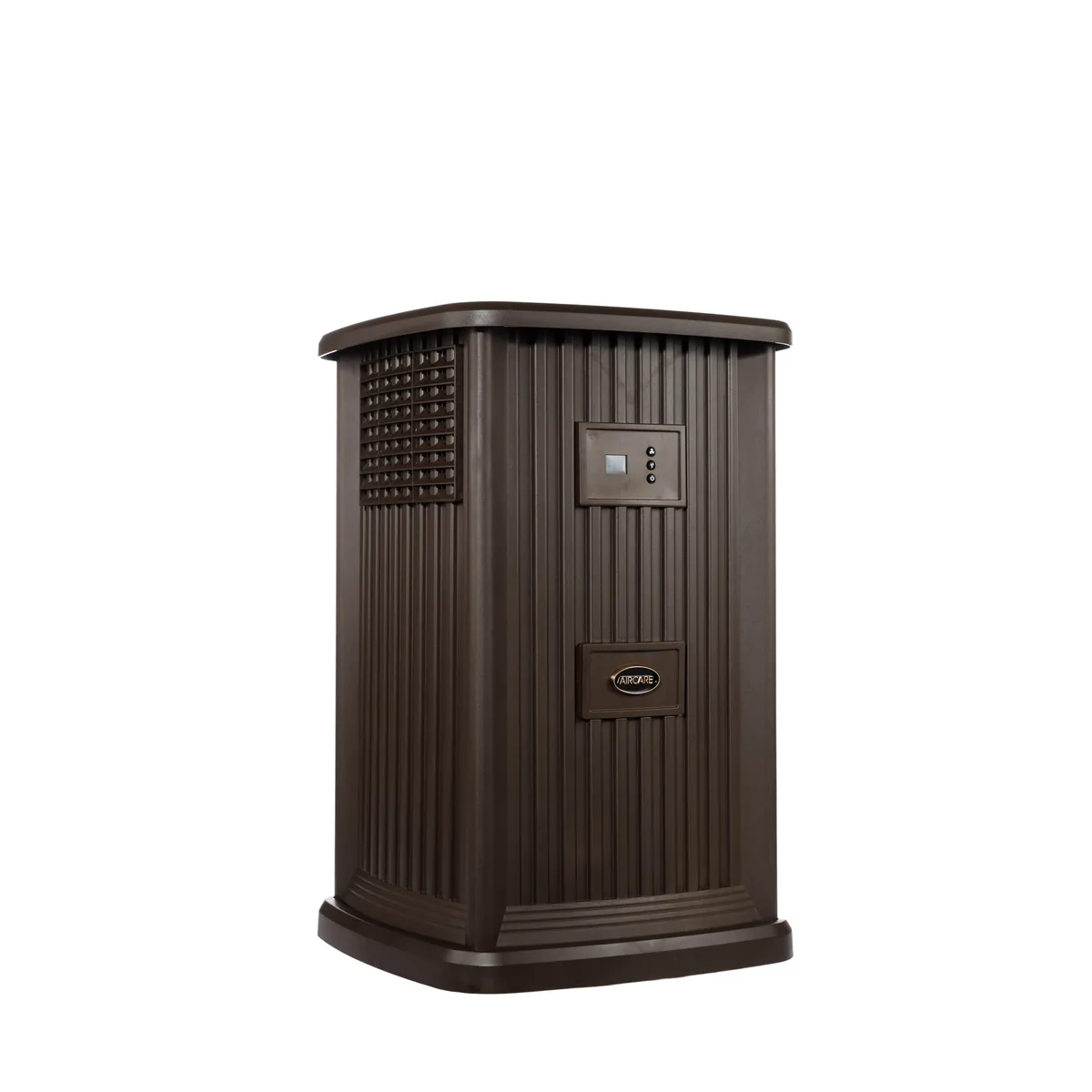
AIRCARE EP9800 Pedestal
AIRCARE's concession to the fact that a console humidifier is a large brown box in a living room. The EP9800 is the same machinery in a pedestal cabinet with a wood finish, meant to look like furniture rather than an appliance - and it half succeeds, which is more than the MA1201 attempts. Nine fan speeds is genuinely useful granularity when you are trying to find the setting that is quiet enough to live with. Output is 7.4 gallons a day against a 2,400 sq ft claim; the calculation supports about 1,820, so it overstates by a third.
1,823 sq ft supported · box says 2,400 sq ft
Levoit
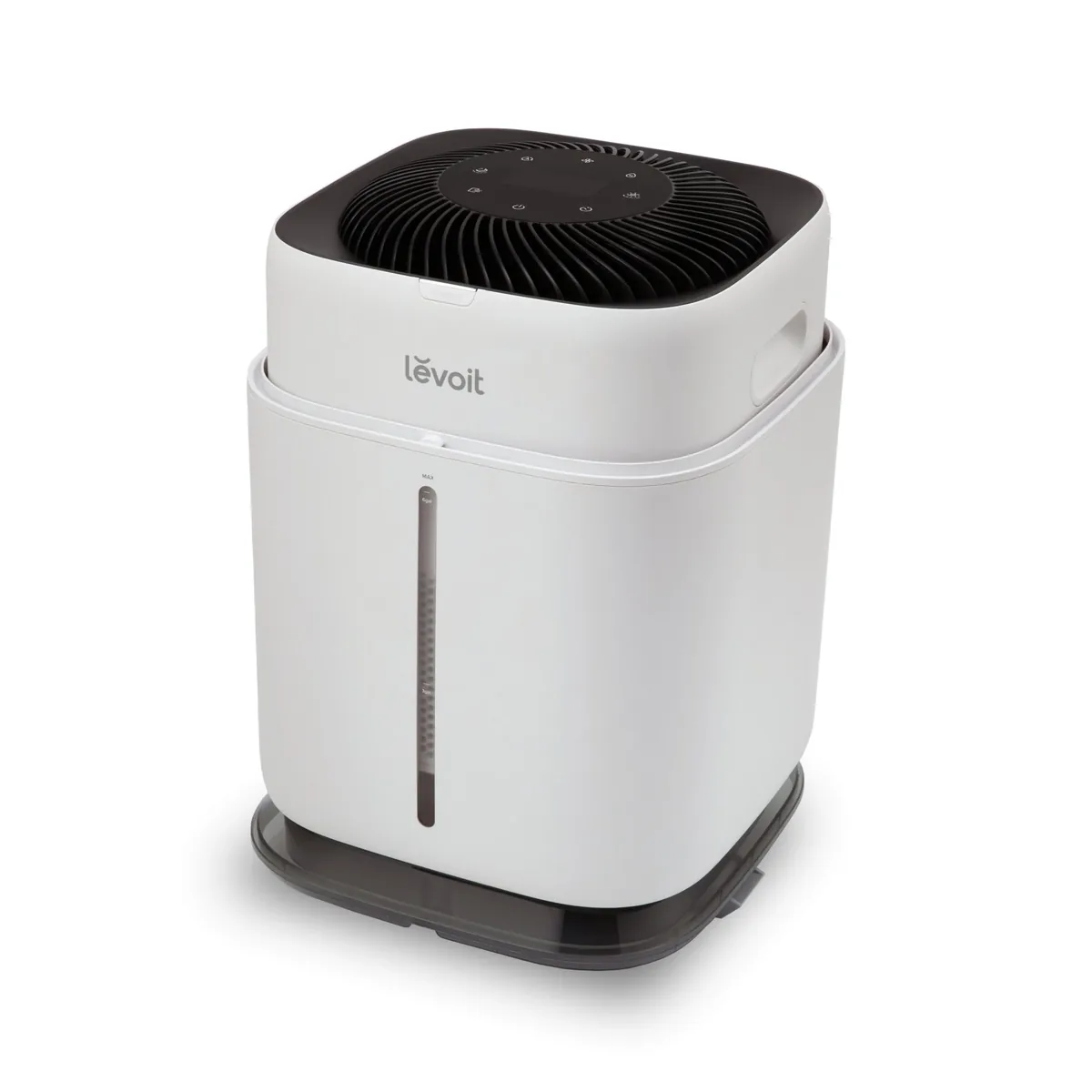
Levoit Superior 6000S
This is what happens when Levoit stops building ultrasonics. A 1,500 mL/hr published output works out to 9.5 gallons a day, which is console territory, and because it evaporates water through wicks rather than atomising it there is no white dust and no mineral film on the furniture. The 3,000 sq ft claim is one of the more defensible in the catalog: the physics supports around 2,300, so it overstates by about a third rather than the three- and four-fold gaps common among the ultrasonics. The cost is a wick habit - four of them, around $40 a set - and a unit you fill through a hose and funnel rather than lifting a tank. Owners who moved from an ultrasonic mostly describe the absence of dust as the thing they noticed first.
2,343 sq ft supported · box says 3,000 sq ft